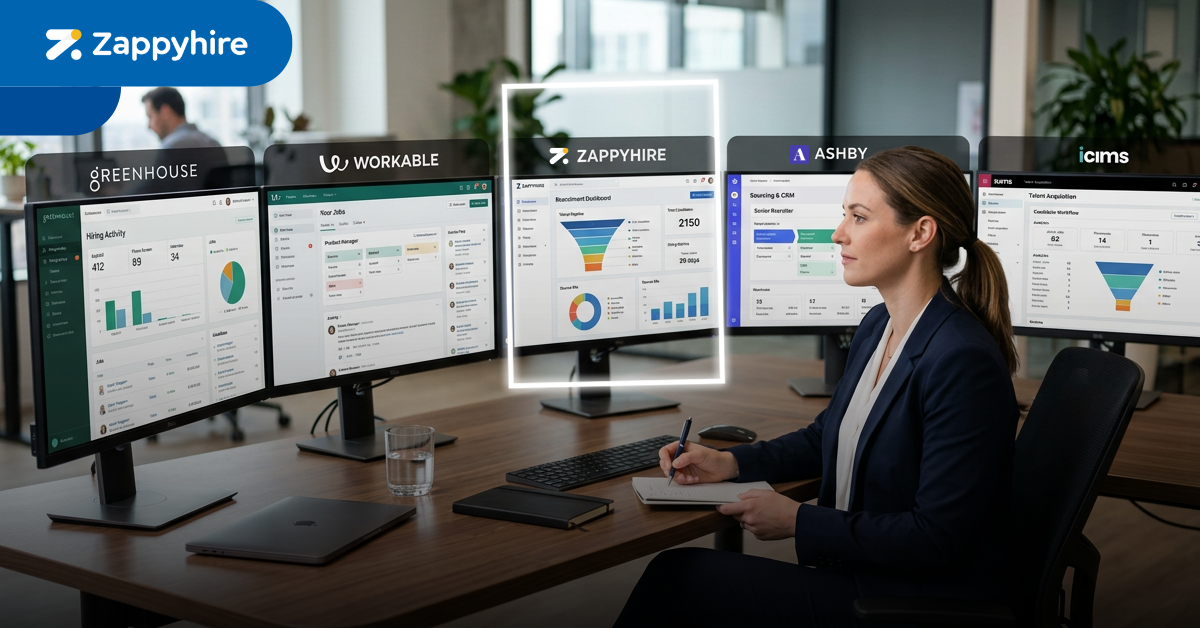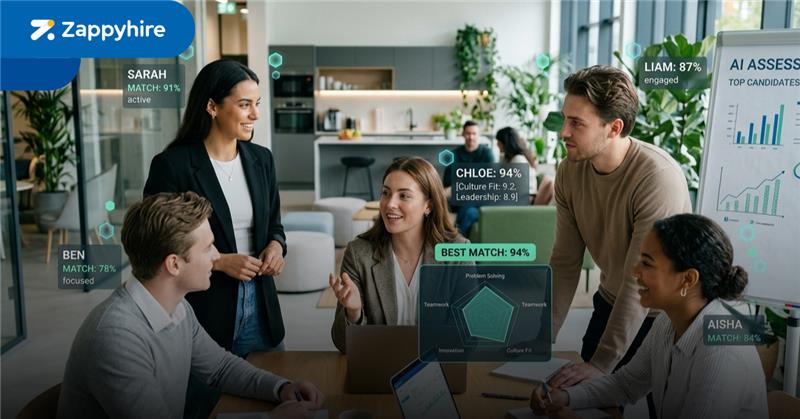
In the past few years large employers have invested heavily in AI‑driven recruiting to streamline high‑volume screening, personalize candidate experiences and help recruiters focus on more meaningful work.
And according to Gartner, nearly 60% of HR leaders say AI-powered tools have already improved talent acquisition outcomes, helping reduce bias and accelerate hiring decisions.
Research from Zappyhire’s AI maturity reporthighlights ten global organizations that have achieved leading levels of AI adoption in recruitment.
These companies hire tens of thousands of people each year and rely on AI tools – resume‑screening engines, video‑interview analyzers, chatbots and predictive analytics – to accelerate hiring while improving fairness and candidate satisfaction.
Leading AI Recruiting Organizations – 2026 Top AI Adopters
| S. no. | Company | Industry | Notable AI capabilities |
|---|---|---|---|
| 1 | Unilever | FMCG | Gamified cognitive assessments, AI‑scored video interviews, automated screening |
| 2 | IBM | IT/Technology | NLP‑based matching, proof‑of‑concept with 15k candidates |
| 3 | Amazon | E‑commerce | Real‑time interview transcripts, AI coding assessments, job‑matching algorithms |
| 4 | Technology | Talent graph & skills matching, machine‑learning recommendations | |
| 5 | Mastercard | BFSI | AI‑enabled screening & analytics, automated interview scheduling |
| 6 | Hilton | Hospitality | Chatbot & virtual interviews, AI‑assisted scheduling |
| 7 | PepsiCo | FMCG | HR tech stack for virtual interviews & data‑driven hiring |
| 8 | Accenture | IT/Consulting | Zero‑touch, agentic AI recruitment at scale (140k hires) |
| 9 | Siemens | Manufacturing | AI‑powered skills‑based hiring, CV‑less assessments |
| 10 | HCLTech | IT/ITES | Generative‑AI‑powered system, AI video interviews |
*The AI maturity leaders’ information has come from Zappyhire’s 2026 research. They represent how deeply each employer has embedded AI into its recruiting processes relative to its industry peers..
About the AI Recruiting Leaders 2026
As artificial intelligence moves from experimentation to operational necessity, recruitment is becoming one of the first enterprise functions to undergo large-scale AI transformation.
The AI Recruiting Leaders 2026 was created by Zappyhire to identify organizations that have moved beyond isolated automation and achieved true AI maturity in recruitment where AI consistently improves hiring outcomes, efficiency, and candidate experience at scale.
Rather than measuring adoption based on tools alone, this report evaluates how deeply AI is integrated across the hiring lifecycle, from sourcing and screening to interviews, decision-making, and workforce planning.
We examined organizations that demonstrated:
- AI usage across multiple hiring stages, not just one-off automation
- Clear, measurable improvements in hiring speed and efficiency
- Consistent implementation at scale across teams or regions
- Strong attention to fairness, bias mitigation, and governance
- A forward-looking roadmap for AI and Generative AI adoption
Why This Matters Now
Hiring complexity is increasing with talent shortages, higher candidate expectations, and pressure to hire faster without compromising quality are forcing organizations to rethink traditional recruitment models.
The companies featured in this report offer an early look at where enterprise hiring is headed: toward intelligent, data-driven systems where AI augments recruiters rather than replaces them.
Their journeys provide practical signals for HR leaders asking an increasingly urgent question: What does future-ready hiring actually look like, and how close are we to it?
Top AI Recruiting Leaders 2026
1. Unilever – AI‑led Hiring at Scale
Unilever processes more than 1.8 million job applications annually, creating huge manual workloads for recruiters.
To fix this, the consumer‑goods giant replaced manual screening with an AI‑powered funnel: applicants complete gamified assessments to test cognitive traits; successful candidates record on‑demand video interviews that are scored by AI; only the top candidates meet human recruiters.
This overhaul reduced time‑to‑hire from four months to four weeks and saved the company over £1 million per year.
Candidate satisfaction improved as 96% of applicants completed the digital process, and the company saw a 16% uplift in hires from under‑represented backgrounds.
2. IBM – NLP‑driven Candidate Assistance
IBM receives roughly 7,000 job applications per day.
Its Watson Candidate Assistant uses natural‑language processing to understand résumés, match skills to open roles and answer candidate queries.
A proof‑of‑concept in 2018 involving 15,000 candidates found that 90% of participants liked the experience and the tool reduced hiring time by over 30%. Now, the tool is being used by IBM India clients as part of its Human Capital Management offering.
3. Amazon – AI‑powered Interview Experiences
Amazon leverages AI across multiple stages of recruitment.
It uses real‑time transcription and analytics during interviews; the transcripts help interviewers stay engaged and provide better feedback, leading 83% of candidates to report more engaging conversations.
Machine‑learning algorithms match candidates to roles, and individuals identified through the AI job‑matching system are 24% more likely to progress after initial interviews.
The company also deploys coding assessments that are tailored to each applicant; 87% of candidates find the AI‑generated questions relevant.
4. LinkedIn – AI‑driven Talent Graph
As the world’s largest professional network, LinkedIn harnesses its extensive data on skills, jobs and relationships to power its AI talent graph.
Machine‑learning models analyze user profiles and job postings to recommend roles, rank applicants and predict hiring outcomes.
According to LinkedIn’s research, this approach reduces screening time by roughly 70% and can cut cost‑per‑hire by up to 50%.
5. Mastercard – Automated Analytics and Fast Scheduling
Mastercard transformed its talent acquisition using an AI‑driven recruitment platform. The company saw a 900% increase in candidate profiles and generated 141,000 more leads than the industry average.
Application conversion rose by 11%, and an intelligent scheduling assistant reduced interview‑scheduling time by 85%, with 88% of more than 5,000 interviews being arranged within 24 hours.
6. Hilton – Conversational AI and Video Interviews
Hospitality giant Hilton uses AI to provide a speedy, high‑touch candidate experience.
The company introduced a chatbot (nicknamed “Connie”) to answer applicant questions, provide status updates and guide candidates through the process.
A video interviewing tool allowed Hilton to reduce its time‑to‑hire from 43 days to just 5 days.
7. PepsiCo – Virtual Interviewing and Data‑driven Redeployment
PepsiCo hires around 60,000 people per year, so efficiency is paramount.
During the pandemic the company shifted to virtual interviewing and standardized its tech stack.
Senior vice‑president of global talent acquisition Blair Bennett notes that virtual interviewing leads to quicker hiring processes and is preferred by candidates.
PepsiCo also used AI‑based matching to redeploy employees displaced by the Ukraine crisis, helping them find new roles.
Though it lacks the level of metrics reported by earlier leaders, PepsiCo’s extensive use of AI tools and data‑driven strategies justify it as a leader in implementing AI in recruitment.
8. Accenture – Zero‑touch Hiring at Scale
Professional services giant Accenture hires roughly 140,000 people a year.
Tom Sayer (Director, Global Recruiting Strategy) described how the firm is rolling out agentic AI to enable “zero‑touch” hiring, which fully automated candidate journeys from application to interview.
This approach combines tools and workflows that deliver frictionless, AI‑led recruitment at scale, eliminating manual scheduling and screening.
Hence, by embedding AI across its hiring processes, Accenture is a leader in AI in recruitment.
9. Siemens – Skills‑based Hiring and CV‑less Assessments
Industrial powerhouse Siemens uses AI to support skills‑based hiring.
Siemens Electrification & Automation (EA) describes how the division piloted CV‑less hiring using task‑based psychometric assessments.
Removing the CV increased application volume five‑fold, improved candidate quality and produced a more diverse talent pool; eight exceptional candidates were shortlisted and three were hired – applicants who would have been missed using traditional CV screening.
Siemens’ recruitment tools also analyze résumés, evaluate skills and predict performance, saving time and reducing bias.
These efforts highlight Siemens’ commitment to AI‑driven hiring.
10. HCLTech – Generative‑AI Recruiting and Video Interviews
HCLTech is both a technology provider and an early adopter of AI in recruitment.
For its U.S. hiring, HCL America used a AI video‑interviewing platform.And in six months, two evaluators reviewed more than 1,200 candidates and saved 200 hours of panel time, demonstrating the efficiency of asynchronous video interviews.
HCLTech is also commercializing a Generative‑AI solution with features such as automated bulk screening that reduces screening time and effort by up to 40%, AI‑generated contextual questions to improve assessment accuracy, personalized feedback to enhance the candidate experience, and unbiased evaluations that promote diversity.
What This Means for Large Enterprises
For large enterprises, hiring is a business infrastructure, and not an HR support activity. It’s. The people you bring in (and the speed at which you bring them in) directly shape execution capacity, customer outcomes, and growth trajectory.
That’s why the “AI Recruiting Leaders” in this list aren’t using AI for novelty. They’re using it to protect three things that break first at scale: decision velocity, consistency, and candidate experience.
1) Talent quality is a growth lever – and a growth risk
“The executives who ignited the transformations from good to great did not first figure out where to drive the bus and then get people to take it there. No, they first got the right people on the bus (and the wrong people off the bus) and then figured out where to drive it. “
— Jim Collins, Author of Good to Great
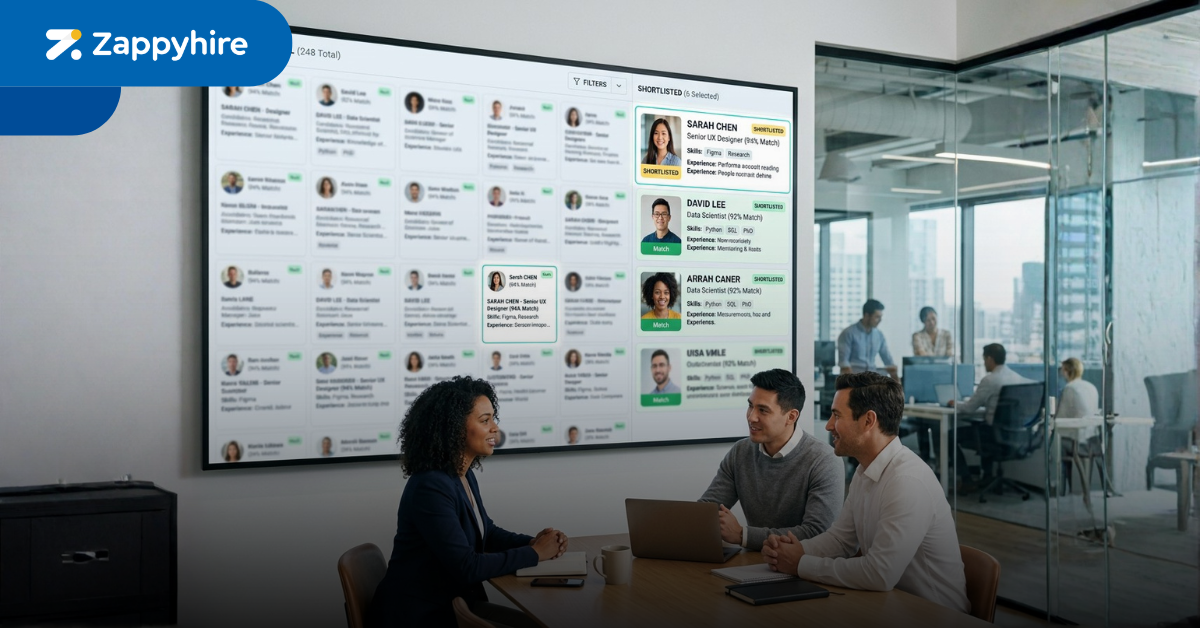
In enterprise environments, the cost of a “nearly-right” hire multiplies: slower delivery, more rework, managerial drag, and attrition spikes that ripple across teams. That’s why many companies are now using AI-powered resume screening and automated candidate shortlisting to improve hiring accuracy at scale.
2) At scale, hiring doesn’t “break” – it degrades
“It’s not like a braking system. It will not break quickly. It’s going to degrade, slow but steady. When the volume increases… the first degradation happens in the early stage filtering itself.”
— Deepu Xavier, Co-founder, Zappyhire
Enterprise hiring rarely collapses overnight. It degrades slowly starting with early-stage filtering, then inconsistent evaluation, then delayed feedback, and finally a poor candidate experience that quietly damages your talent brand.
Deepu’s framing is especially useful here – if volume increases without systems, recruiters move from evidence-based screening to pattern-based heuristics. That’s when quality drops and the funnel fills with “average” candidates.
A structured interview funnel supported by automated video interviews helps maintain consistency even as hiring volumes grow.
3) AI won’t fix chaos – it will amplify it
“The most important derailing factor is our data and the quality of data… let it be an AI system or an Excel.”
— Aravind Warrier, Lead – People & Culture, VOLVO India
There’s a warning here too: enterprises don’t need “more automation.” They need better decision-making architecture. AI can support it, but it can’t replace the fundamentals like clean data, aligned workflows, and a shared understanding of what “good” looks like.
So the goal is not “AI everywhere.” The goal is: clean processes first, then automate processes by strong foundations such as a structured AI-powered Applicant Tracking System (ATS) and data-driven hiring practices.
4) The TA role shifts from “processor” to “talent advisor”
“Each and every recruiter today needs to become talent advisers.”
— Anushri Madhugiri, Leadership & Talent Advisory, Reliance Group
One of the strongest changes is recruiters can’t stay as “resume downloaders.” In enterprises, TA has to evolve into talent advisory by bringing structure, feedback loops, and stakeholder alignment to the table.
That shift matters because enterprise hiring is a multi-stakeholder system. If hiring managers, recruiters, and leadership aren’t speaking the same language (capabilities, competencies, evaluation standards), you don’t have a hiring process – you have disconnected opinions.
When recruiters move from processing resumes to strategic advisors, they now rely on tools like structured interviewing frameworks and collaborative hiring systems.
Why AI Adoption in Recruitment Matters for Big Corporations
AI Maturity Correlates with Hiring Speed
Companies like Unilever, Hilton and Mastercard cut hiring cycles from months to days by automating assessments, interviews and scheduling.
Candidate Experience Matters
AI tools that personalize assessments and provide real‑time transcripts improve engagement and satisfaction; Amazon and IBM report high candidate approval rates
Bias Reduction and Diversity
AI screening tools remove identifying information and evaluate skills objectively, leading to more diverse hires at Unilever, PepsiCo, Siemens and HCLTech.
Scale Requires Automation
Organizations hiring tens of thousands of people each year must automate bulk screening and scheduling; Accenture and HCLTech illustrate how generative AI can handle this scale.