At the current job market, employers are drowning in applications. At the same time, job seekers expect a fast, transparent experience, and recruiters must make sense of massive data without sacrificing fairness.
How are large companies solving this issue? Simple answer – AI candidate screening.
“In volume hiring, AI plays a big role because it’s practically impossible to review every application manually.”
— Anushree Madhugiri, Leadership & Talent Advisory, Reliance Group
AI-powered tools can quickly sift through résumés, video interviews and assessment scores, identifying high‑potential candidates while allowing humans to focus on connection and judgment.
Plus, candidates benefit from quicker updates, consistent evaluations, and fewer “application black holes,” making the hiring process feel clearer and more respectful of their time.
But implementing AI for large‑scale hiring isn’t as simple as flipping a switch.
So, let’s explore why AI candidate screening matters, what real‑world data shows about its impact, the risks of bias and fairness, and how to adopt AI while keeping the human touch.
When You Should Implement AI Candidate Screening
AI candidate screening becomes important when scale starts breaking your existing process.
“Even with the best tools, it’s still manual interventions that inhibit the whole flow.”
— Aravind Warrier, Lead – People & Culture, Volvo India
If your hiring team is overwhelmed, reactive, or struggling with consistency, it’s a signal that automation and intelligent filtering are no longer optional.
You should seriously consider implementing AI screening when:
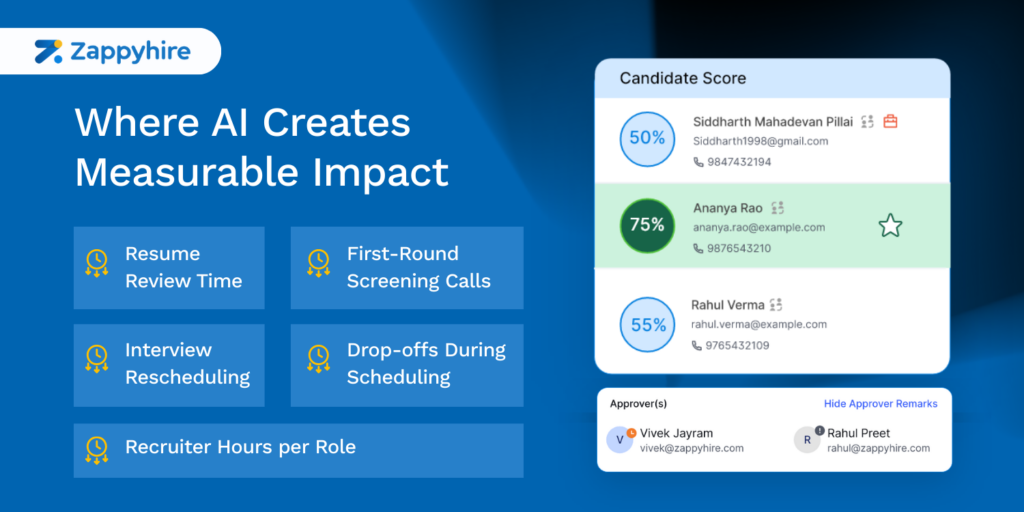
- You’re handling a high volume of applications per role and manual resume review is slowing down time-to-hire.
- Recruiters are spending excessive hours shortlisting, leaving little time for stakeholder alignment or candidate engagement.
- You’re receiving too many unqualified applications, making it hard to identify top talent quickly.
- Interview scheduling delays are causing candidate drop-offs or frequent cancellations.
- Inconsistent screening decisions are creating fairness or bias concerns across teams.
- Time-to-hire is increasing despite adding recruiter bandwidth.
- You’re expanding across multiple locations or business units, making standardized evaluation difficult.
- Hiring spikes (seasonal, campus recruitment) are stretching your current infrastructure.
If any of these challenges sound familiar, AI candidate screening can help you create structured, scalable, and data-driven hiring workflows, without sacrificing candidate experience or human judgment.
Benefits of AI Candidate Screening in a Large Organization
High Application Volumes Demand Automation
Recruiters at enterprise organizations are under pressure to fill roles quickly while managing a deluge of applications. Traditional methods like manual résumé reviews and unstructured interviews aren’t built for scale.
“Enterprises receive hundreds, sometimes thousands, of applications per role. A recruiter may screen 500 profiles, speak to 10–20, and move forward with 5–6. It’s not poor screening – it’s limited bandwidth. You cannot speak to all 500. Manual intervention becomes the bottleneck.”
— Deepu Xavier, Co-Founder of Zappyhire
Research from the World Economic Forum reveals that more than 90% of employers now use automated systems to filter or rank applications.
The reason is simple: humans alone can’t review millions of submissions without missing qualified talent.
AI Drastically Improves Efficiency
Data backs up the efficiency gains.
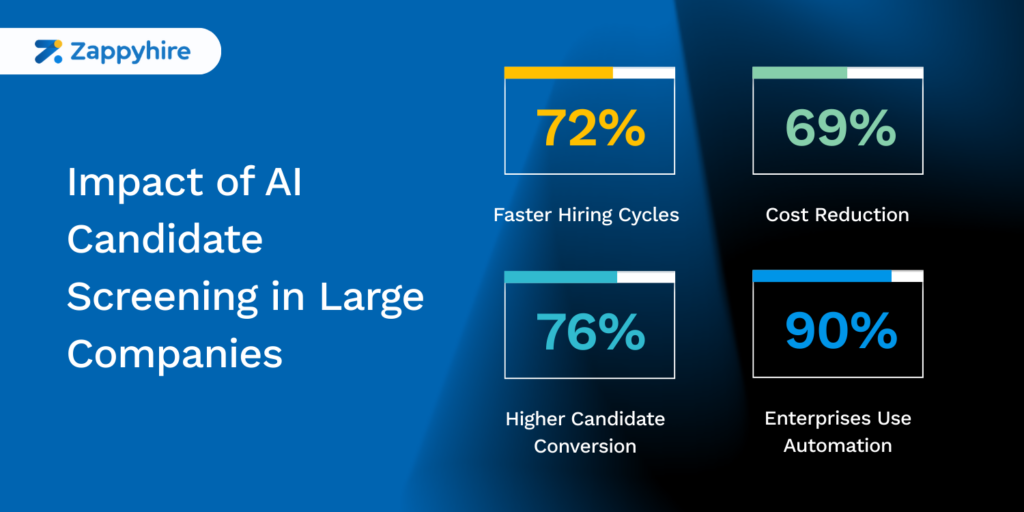
Across success stories, organizations report up to 72% faster hiring cycles, 69% cost reductions, and a 76% boost in candidate conversions, proving that AI-led recruitment drives both speed and quality at scale.
The State of AI Adoption in Recruitment report by Zappyhire found that around 80% of hiring teamsuse AI somewhere in the hiring process and report significant improvements in hiring efficiency.
There’s a Strong Business Case For AI
The SHRM Talent Trends report notes that nearly nine in ten HR professionals whose organizations use AI say it saves time or increases efficiency, 36% say it reduces costs, and 24% say it improves the ability to identify top candidates.
Insight Global’s survey found that 95% of hiring managers plan to increase AI investment, while 93% emphasized that human involvement remains essential.
How Does AI Candidate Screening Actually Work in the Recruitment Process?
AI candidate screening is often misunderstood as a “black box” that magically selects the best resumes. In reality, it’s a structured layer built into specific stages of the hiring funnel to reduce manual effort, improve consistency, and help recruiters focus on the right candidates faster.
Let’s break down how it actually works inside a modern recruitment process.
1. Resume Parsing & Data Structuring
Before AI can evaluate anything, it needs structured data.
When candidates apply through an AI-powered Applicant Tracking System, the system automatically:
- Extracts information from resumes (skills, experience, education, certifications)
- Standardizes job titles and experience formats
- Maps candidate data to predefined job requirements
- Identifies missing or incomplete information
Instead of recruiters manually scanning 300 resumes, the system converts all applications into searchable, comparable profiles within seconds.
What this solves – Manual screening time, inconsistent evaluation criteria, and messy candidate databases.
2. Job Description Analysis & Matching
AI screening doesn’t just look at resumes. It also analyzes the job description.
Here’s what happens:
- The system breaks down the JD into required skills, preferred skills, experience range, and role complexity.
- It analyzes the information as per the qualifying criteria and weightage you have set for different skills.It ranks applicants based on match percentage.
With agentic AI-powered recruitment automation, recruiters can automatically shortlist candidates who meet predefined criteria without manually filtering applications one by one.
What this solves – Subjective shortlisting and inconsistent recruiter judgment across hiring teams.
3. Knockout Filters & Eligibility Checks
This is one of the simplest but most powerful layers of AI screening.
Before a recruiter even sees a candidate, the system can automatically filter based on:
- Location requirements
- Notice period
- Experience range
- Mandatory certifications
- Salary expectations
Candidates who do not meet non-negotiable criteria are flagged or moved to a separate workflow automatically.
This eliminates repetitive manual filtering and allows recruiters to focus only on viable candidates.
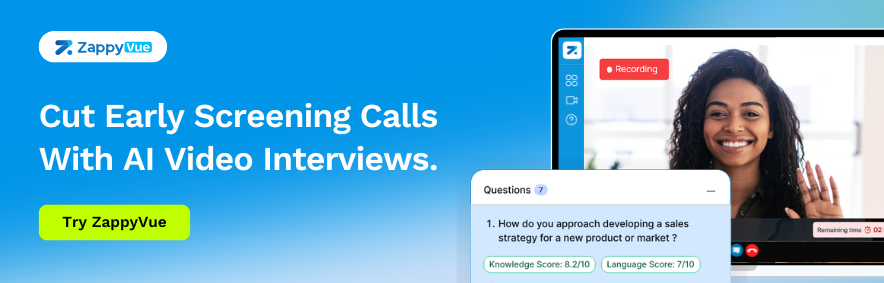
4. AI-Powered Video Interview Screening
This is where AI goes beyond resumes. Using tools like ZappyVue, candidates complete automated video interviews at their convenience. The AI then:
- Analyzes responses against role-specific competencies
- Evaluates communication clarity and content relevance
- Scores answers based on predefined evaluation parameters
- Highlights top-performing responses
- Flags weak or irrelevant answers
Recruiters don’t have to schedule early screening calls. They simply review structured video responses along with AI-summarized scoring and insights.
What this solves – Time spent on repetitive first-round screening calls and interviewer availability issues.
5. Automated Scoring & Shortlisting
Once resume match, eligibility filters, and interview responses are analyzed, the system:
- Creates consolidated candidate scorecards
- Ranks applicants based on overall performance
- Provides side-by-side comparisons
- Suggests shortlists
Recruiters retain full control but operate with data-backed insights instead of intuition alone.
Best Practices for Implementing AI Candidate Screening at Scale
Here’s a roadmap to implement AI screening effectively while avoiding pitfalls:
- Define objectives and metrics – Clarify what problems AI needs to solve – e.g., reducing time‑to‑hire, improving quality of hire, enhancing diversity. Establish metrics such as resume‑screening time, candidate satisfaction and diversity ratios.
- Choose the right AI partner – Look for top AI recruitment tool vendors with transparent algorithms, ethical AI practices and case studies demonstrating fairness. Avoid black‑box systems and look for custom fields to allow hiring teams to tailor screening criteria to specific roles and values.
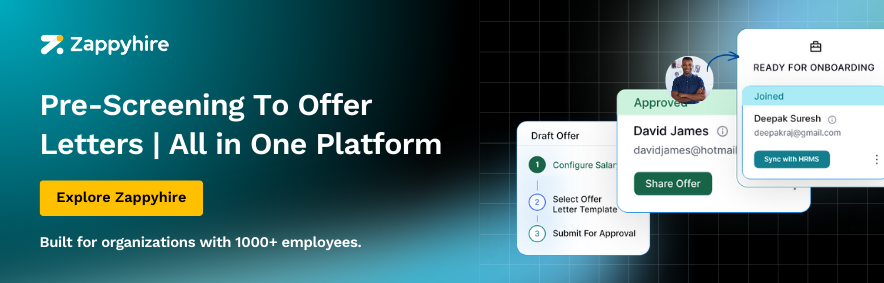
- Integrate with your ATS – Seamless integration ensures that AI screening works alongside your existing applicant tracking system (ATS) and candidate database. Zappyhire’s recruitment automation platform ideal for companies with over 1000 employees acts as both an ATS and screening solution, letting recruiters manage candidate profiles, schedule interviews and send offer letters from one dashboard.
- Ensure human oversight- Always involve recruiters to review AI recommendations and conduct final interviews. Set thresholds for automatic advancement but empower humans to override decisions. Tools like Zappyhire allow collaborative scoring and notes, making it easy for panels to align on top candidates.
- Prioritize fairness and auditing – Choose AI solutions that allow auditing for bias and audit your recruitment process regularly.
- Enhance the candidate experience – AI should speed up the process and provide transparency. Consider chatbots that answer questions and schedule interviews.
- Train recruiters and hiring managers – AI adoption isn’t just a technology project; it involves change management. Provide training on interpreting AI scores, conducting structured interviews and communicating AI decisions to candidates.
- Monitor and iterate – Continuously measure outcomes. If AI‑recommended hires perform better or time‑to‑fill drops, reinvest; if you see adverse impact on certain groups, adjust training data and algorithms.
Balancing Efficiency with the Human Touch
Human Expertise and Empathy Still Matter
AI can screen thousands applications, but it can’t replace human connection.
“Predicting the culture fit… that’s something that is done only by an experienced senior… AI cannot solve that for us.”
— Anushree Madhugiri – Leadership & Talent Advisory, Reliance Group
She sees the best AI as removing drudgery so recruiters can focus on empathy and insight.
Diversity and Inclusion Depend on Human Oversight
While AI can mitigate some biases, it can also reinforce discrimination if not carefully designed.
A study by the Brookings Institution tested résumé‑screening algorithms and found that resumes with male‑sounding names were favored 51.9% of the time, while female‑sounding names were favored only 11.1%.
When comparing racial cues, white‑associated names were selected in 85.1% of cases versus 8.6% for Black‑associated names. Intersecting biases meant that resumes with Black male names were only selected 2% of the time. These findings highlight the necessity of continuous auditing and diverse training datasets.
The Human–AI Handshake
Analysts predict that 2026 will be the year of the “human–AI handshake”, where technology is widespread but the differentiator becomes human readiness and culture.
“Even if the system has done the due diligence on skills… your human judgement comes into play. That’s where you do the cultural fitment.”
— Aravind Warrier, Lead – People & Culture, Volvo India